Monday, 30 March 2020

LEARNING TASKS FOR LOCKDOWN


Social isolation and being locked down for a long period of time will greatly impact everyone's wellbeing and mental health. This is particularly very true for our students who have been spending their time substantially at schools and tuition centres with friends and teachers. Being used to be in the company of others, a sudden lockdown will leave them with a sense of loss or may lead to severe depression. Therefore, it is important for us as teachers to reach out to our students at times like this and keep them busy. 

From my social media account, I noticed that many teachers in Malaysia are attempting online educational tools and apps such as google classroom to get connected to their students and keep them engaged with teaching and learning activities. Hats off to these teachers who have maintained a balance working from home and keeping their students' high in spirit. 

Just like those teachers, I have also developed some ideas and worked with my students since the CMO was announced. It was a blessing that I had already set up telegram groups with all the four classes that  I am teaching at the beginning of the year, to give them instructions and tasks whenever I am not at school. So this set - up came in handy at times like this. 

At first, I wanted to use google classroom as a platform to assign tasks for them. However, I noticed that too many teachers are using that as a platform to keep 'in touch' with their students. Therefore, I decided to do something else. 

Scrapbook Project

The first task that I gave them was a scrapbook project which I adapted from the Fullblast textbook (page 131). Students are required to complete a scrapbook on one of the seven wonders of the world in about 10 pages. I asked them to use the materials that they have at home. They are to share their scrapbooks with friends once they are back to school after the CMO. I gave them a few datelines for this project. 1 day to plan,  2 days to design the cover, and another two days to write their introductions. The rest of the days I gave them a few other tasks that will eventually lead to the completion of the scrapbook. All instructions have been given via telegram apps. Take note that many of my students do not have smartphones, so I asked them to use their parents' phones to communicate with me, so basically, parents know what their kids are doing. The following are some of the cover pages that the students have submitted to me through the telegram app. 

Cover Pages of Students' Scrapbook Project

Lessons Via Youtube Videos 

Besides project work, I have also created (and in the midst of creating)  a few task-based lessons for my students on Youtube and shared the links with my students. The lessons are mostly writing lessons or ideas for creative writing. Along with the video, I have also created task sheets to aid learning. The task sheets are saved in google drive and the links are posted together with the videos. Students may print out the task sheets or copy the instructions from the task sheets into their exercise books to complete the tasks assigned to them.  This way, students are free to watch the videos whenever they are free at home. 

Some other tasks that they are to do while/after watching the videos are :

1. like the videos. 
2. State a lesson learnt from the story/ write three/five new things learnt from the videos at the     
    comment section.

                                    https://www.youtube.com/watch?v=pg0NBZm3ltg&t=41s     


                                  https://www.youtube.com/watch?v=lC1LoFCcEJ0&t=34s 


                                        https://www.youtube.com/watch?v=SD_HgXgamhc

That is all from me for now, I hope what works well for me will work for you too.

Will share more videos soon!

Till then, stay healthy and stay safe.

Wednesday, 15 January 2020

English Language Form 4 - Writing (Lesson 5)


I have been busy with a lot of work for the last few days and could not share much. However, I find time today to share a writing lesson which I developed recently. This lesson is based on the Form 4 Fullblast Textbook (pg.13). 

Well, before I get started, as teachers it is important for all of us to remind ourselves that essay writing is the major part of secondary school and it is our responsibility to explore different ways to engage our students in writing. For some of us, making our students write essays may be a daunting task but that does not mean we should give up and make them copy sample essays instead. So, please try a variety of activities to engage your students in writing lessons. Some may work and some may not. Don't just give up yet!!!

Now, let us get into the lesson. 

For the introductory activity, students were asked a few questions about webpages and websites and how they differ from one another. Learners were then directed to the following reading task : 


Students were required to read the text above and as they read, they were to underline all the sentence starters in the text. They also identified all the linking words in the text such as and, but, so and because. 
After reading, students 'shouted out' the list of sentence starters, followed by the linkers. The teacher listed them on the whiteboard. 

In the next task, students were required to work in their small groups. They were to identify three from the eight categories to brainstorm ideas.  As they brainstorm, they were also reminded that they could actually pick ideas from the text that they have read earlier. I also asked them to write their sentences using the simple present and present continuous tenses(They learnt these in lesson 2). 


After the brainstorming activity, students worked in their groups to create a webpage for "Aminah". They used all the ideas that they have gotten from the text and brainstorming activity to complete their webpages. The following pictures were taken while students were preparing their webpages. 


The following are some examples of the students' completed task : 


After completing the webpages, students did the "Gallery Walk' activity. They moved from one group to another and spent about two minutes identifying spelling and grammatical errors. They were told that the ideas should be developed in simple present and present continuous tenses just like how Ahmad's webpage had been developed. Students were reminded to only work on these two errors and write one thing that they like about the webpage. The pictures below were taken while students were doing the "Gallery Walk" activity. 


All the activities above helped students to build ideas and knowledge that would help them to write up their own webpage. I believe that students have learnt a large deal through all the activities and they are up for an individual task.

So, I asked them to write their own personal webpage by picking any 3 out of the 8 categories of ideas as their homework. The essays must be in about 150 to 200 words.  

And that's all for now.... Happy Teaching and Happy Ponggal to those who are celebrating it!!

Monday, 6 January 2020

English Language Form 4 - Lesson 2 (Language Awareness)


Today I had my second lesson with 4S1 on language awareness which is the second lesson in Form 4 CEFR - aligned Scheme of Work.

So this was how the lesson went : 

After introducing the success criteria, I gave 5 minutes for the students to discuss Simple Present and Present Continuous in their groups. They had learnt these tenses while they were in  Form 2 and 3. So, this lesson was an extension of what was learnt in previous years. The discussion was to activate their schemata. 

The discussion led to the next activity where students had to identify Simple Present and Present Continous in a teacher prepared task sheet and they were also required to identify and circle all the Stative verbs used in the sentences. You can download the task sheet here. 

Upon completing Task A in the task sheet, students were asked to put the task sheet aside. I continued the lesson by directing students to look at page 9 in their textbooks and gave examples of the two tenses that were being focussed. We also discussed how Simple Present Tense and Present Continuous Tense were used in context by referring to the text on Social Networking Sites(page8). Students were asked to identify all the Simple Present and Present Continuous Tenses in the text. Stative verbs were also discussed. 

After the discussion ended students were asked to look at the task sheet again and check and correct their answers. Task B in the task sheet and the grammar practise in the textbook were given as homework. 

After completing the tasks, students played a board game. To play this game you need a dice and also a striker. This is how the game is played:  

1. The game has words that are used in the text on Social Networking Sites and some are related to computer vocabulary. 

2. At the bottom of each word, it is stated Simple Present or Present Continuous. 

3. Students who stop at Present Continuous will have to verbally construct a sentence in Present Continuous and if they stop at Simple Present, they will have to construct a sentence on Simple Present. 


5. For every correct sentence, students get 2 marks and a deduction of 2 marks for wrong 
    sentence-construction (I made the rules simple, as to not complicate things). 

The pictures below were taken when my students were playing the grammar boardgame. 


Before the lesson ended, students completed exit cards on what they learnt today. 

Happy Teaching!!

Saturday, 4 January 2020

Ready to Print Exit Cards!!


Exit cards are often used in post - lessons to get students to summarise the lesson learnt or to display what they have understood at the end of a lesson. Exit cards can be in many different forms and teachers can actually design their own exit cards based on what is relevant for their lessons. 

After referring to some online and offline resources,  I have prepared different types of exit cards which I am planning to use in my lessons and I thought of sharing them here. Exit cards can provide us with immediate information that we can use to assess our students' understanding, monitor their progress and to gather feedback on our own teaching. Exit cards do not only help us to assess our students but it is also a way for us to reflect our own teaching practices. The following are some of the exit cards that I am sharing here. 

a) Summarising the lesson


This is an interesting way to summarise the lesson. If you are having a speaking and listening task, you may want your students to reflect whatever they have listened and spoken in a written form. This exit slip can be a great way to reflect whatever learnt during listening/speaking lesson. 

b) Writing the summary of a lesson and listing new words


Besides summarising, if you are exploring new vocabulary in your lesson, this exit card will be a suitable one. This will help us to assess students' vocabulary gain at the end of the lesson. 

c) Answering simple questions


We can also use exit cards with three simple questions. I think this exit card will be suitable when we teach grammar. This will help students to reflect on new grammar rules that they learn. Undeniably this can also be used for other lessons. Look at the questions and think whether the exit card is relevant for your lesson before using it or else students will return empty papers. 

d) 3 - 2 - 1 


This is a common exit slip that can be used in almost all lessons but remember not to use it too often as students will get bored doing the same thing. A little variety will spice up things and help students to put on their thinking caps.  I have used this particular exit slip many times in previous years and not planning to use it this year.  

e) Reflection slip


When you use this exit slip, you are actually giving your students the liberty to decide whether or not they like the lesson. So, if you want your students to assess your lesson, this is one simple and quick way. 

f) Your opinion matters 


This is another exit slip where students are required to form an opinion around the topic discussed and they are to give relevant details to back up their opinion. This exit slip will be suitable when we are discussing topics related to certain issues, just like the reading task in unit 1 in the form 4 textbook where it discusses issues related to social networking sites. 

You may download the ready to print pdf version of the exit slips here. You may print in coloured papers of your choice. 

Happy Teaching!!! 


Friday, 3 January 2020

Reading Activity - Full Blast Unit 1


I began my lesson this year with a reading activity. This lesson is based on the 'Full Blast!' textbook, page 8.  I did not try anything ambitious as my intention is to develop my students reading skills using simple activities that will work for everyone, especially for my students. 

So, this was how the lesson went : 

Before I began the lesson, I put my students into small groups and they remained in the same groups throughout the lesson.  

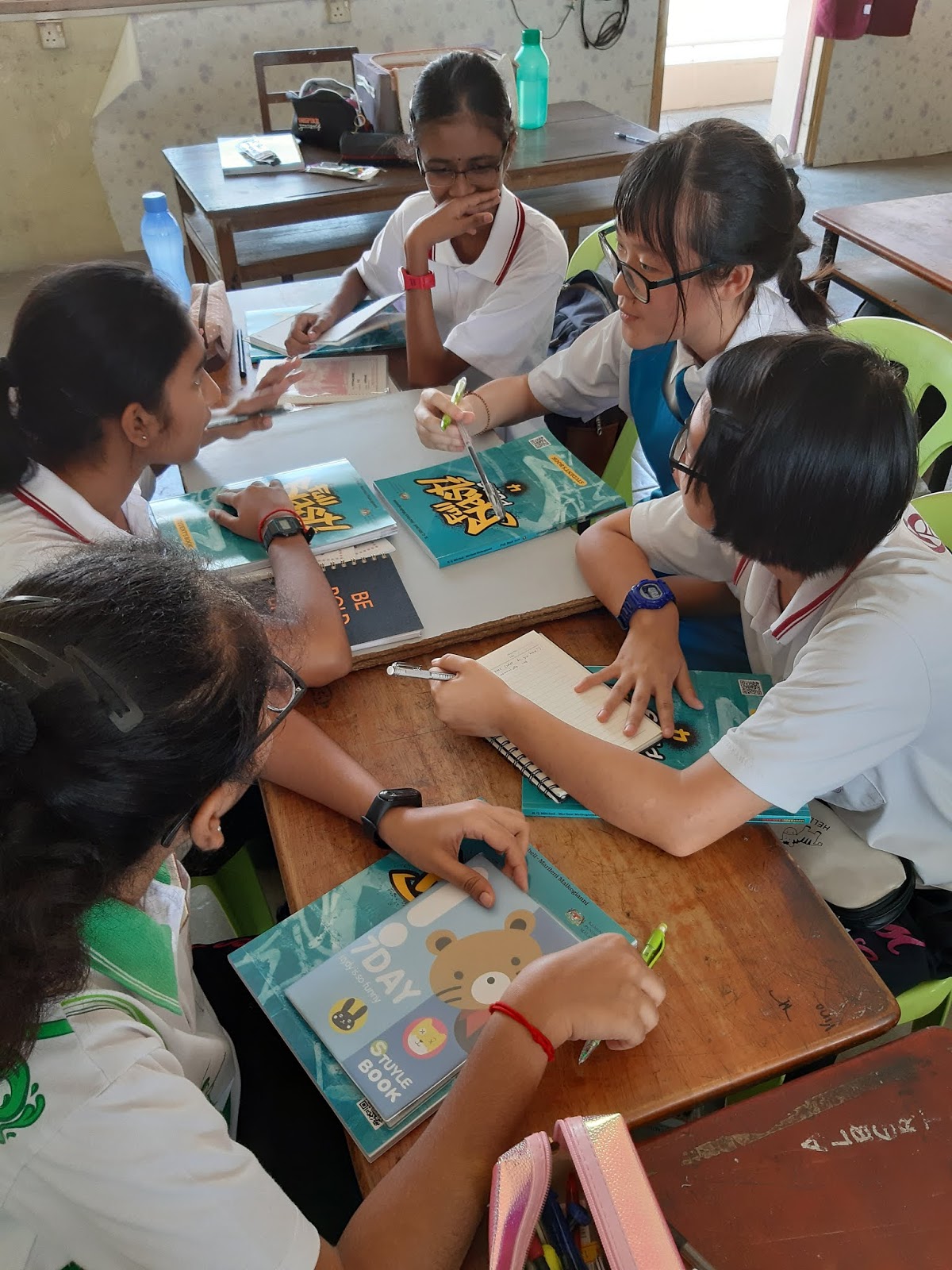
For the pre-reading activity, I wanted to activate students prior knowledge on social networking sites(SNS), so students were given three questions to be discussed in their groups. After discussion, each group choose a representative to share the outcome of the group discussion. The sharing session then led to the next activity. 
The first round of discussion is in progress 

For the next activity, students were required to read the text assigned to them individually. There were four students in a group and each of them was assigned one section of the text. I also prepared supplementary task sheets to help them with the reading activity. You may click here to download the task sheet. As they read, students were required to fill in the necessary information in the task sheet provided and share them during the discussion with the rest of the class. They were required to identify the opinions of each individual about SNS in the text and together with the opinion they were also identified reasons given for the opinions. After completing the task,  students exchanged their answers with members from other groups.
Students completing tasks given in the supplementary task sheet while reading the text.

Students completed the supplementary task individually before discussing as a group

A student sharing opinion  and reason 

Upon completing this, I drew students attention to the next activity in the task sheet, where they have to read through the entire text again as a group to identify the advantages and disadvantages of SNS. Again, to save time I asked them to complete the task in their respective groups. After completing the table, students were asked to shout out their answers for the teacher's approval. This activity is followed by task C and D in the student's book. 

Students found it easier to complete task C and D in the textbook as they had read the text more than twice and understood the opinions of each individual in the text through the supplementary task. 

The next activity was speaking, due to time constraint, students were required to stay put in the same groups. I used talking chips so that students will be focussed and know their roles. Each student was given 8 chips. The chips have three different colours. Two pink chips for questioning, three blue chips to respond to a statement/question/answer and three yellow chips for them to state their opinions. The speaking task was very organised due to the use of the talking chips. 


Students are engaged in speaking task using the talking chips.


As a closure for this lesson, a few students were randomly picked using ice-cream sticks to share what they have learnt today. 

Happy Teaching!!!


Thursday, 19 December 2019

Classroom Tools for Writing Lessons


The following are some tools that can be used during our writing lessons to enable our students to assess their own and peers' compositions before handing them in to the teacher. These rubrics have been designed in a way to make our students check for simple errors before submitting their work. 

Self - Assessment Rubric 
The self - assessment rubrics are designed to help students to check their own essays before submitting them. The rubrics here have listed a set of 'to-do' things that guides students to check their work. The lists are simple and understandable. Students can easily figure out what they have done and what they need to improvise before submitting the final work. As for the teacher, it would be easier for them as they would only need to work on the technical parts. The three editing checklist that I have shared here are different in their own ways. We can always alter and make minor changes to them so that the rubrics are well - aligned to the task given to the students. 

Self - Assessment Rubric 1 


Self - Assessment Rubric 2 


Self - Assessment Rubric 3 

Peer Assessment Rubric
The following are different types of peer assessment rubrics. These are different types of tools for different types of writing tasks and involves one or two peers as assessors depending on the task given. I have constructed these rubrics as simple as possible so that my students would understand what is stated in the rubrics. However, if you find them to be too difficult for your students you can always simplify these rubrics to suit your students learning needs.  


Peer Assessment Rubric for Descriptive Writing 

Peer Assessment Rubric for Paragraph Writing

Peer Editing Checklist

Peer Assessment Rubric 

Peer Grading Rubric
Teacher Assessment Rubric 
The teacher assessment rubric is designed for teachers to assess their students' work and give them scores for six different criteria and each criterion has three scores to show students what they have achieved and what they have to work on. This is in a way replicating the medal and mission model. 

Teacher Assessment Rubric - First Page 

Teacher Assessment Rubric - Second Page

You may download the rubric here

Happy Teaching! 

Saturday, 14 December 2019

Classroom Tools for Reading Lessons


As a teacher, I have always believed in making my lessons interesting by creating meaningful classroom activities for my students. The worksheets and tools that I design are to help me to achieve the objectives of my lessons. The following are some classroom tools that can be used for reading lessons. These tools are designed to help students to understand their responsibilities as learners while doing a reading activity. I find these tools help to create a sense of purpose among students. 


The self - assessment rubric for reading is designed to help learners understand what they need to do while reading as to develop their skills. By referring to this rubric they will be able to understand what they need to do in order to display understanding while reading a text. At times,  students may not understand the rubric, so we teachers can actually demonstrate how to use the rubric. We also need to help students to explore the reading skills so that they know what to do. We as teachers have to remember that reading task is not about reading a text and answering questions. There are more to it, and this is one of the rubrics that may help students to understand what they need to know.  


The Reading Grid is a set of tasks that can help our learners to be actively engaged in reading. There are 16 tasks altogether and students can be given a choice on picking 5 tasks they would like to do. This reading activity can also be done in groups of four where students can pick activities of their choice and work individually, then they can share the outcome with the rest of the group members. As teachers, we have to ensure that the text they are working on will allow them to do all the tasks. If any of the tasks is not do-able, it is important to inform the students not to select the task.

The self - assessment reading chart shown above has listed 10 can do statements that are related to reading activities. Learners can be asked to complete the assessment for reading after a reading lesson so that they would know what they have achieved and what they need to work on. This chart can also help learners to understand what is expected of them during a reading lesson and develop a sense of purpose for reading. Probably after the first assessment, we will get more 'yes' for the second time as students will be more aware of things that the should do.

This is just another version of self - assessment tool, to help learners to understand what they have achieved and what they need to work on while reading to understand a text better. 


The assessment tool shown above is slightly different as the can do statements have been put into four categories. This assessment tool is more suitable to be used when we are dealing with higher intermediate or advanced groups.


The is used for wrap - up activities after a reading lesson. This is quite a commonly used tool for post-reading activities. I have used this quite a number of times and it worked really well in my classes.

As a teacher, I think the tools alone will not help us to develop our students' reading fluency. These are just tools that may help to make our teaching better. We, teachers, have to think of ways and activities on how to develop our students reading fluency with the aid of the tools. So do not solely rely on the tools that I have shared, make sure the reading activities are interesting. I will share interesting reading activities soon enough.

 Please click here to download the PDF version of the tools for reading lessons.   


Related Posts Plugin for WordPress, Blogger...