Showing posts with label ELT. Show all posts

Saturday, 11 July 2020

Understanding 'A Poison Tree' through Poetry Bingo!


In my previous post, I shared a poetry lesson I had with my students after the school reopened. As a follow up lesson to check how much they had understood the poem, I decided to do a poetry bingo with them. 

Zoe - Trying to get her first 'BINGO!'


The lesson was intended to check how much they had understood (formative assessment)  the poem from the previous lesson. This was done to ensure students' understanding of the poem 'A Poison Tree' and planning the 'What's next?".So, I decided to try out 'POETRY BINGO' with them. 

The reason I chose Poetry Bingo because I wanted to them to enjoy learning poetry. At the same time while maintaining social distancing in the class, they could do something fun.  

Ever since they came back to school on 24 June, they did not get the opportunity to move and do exciting activities as teachers were worried that they might be reprimanded for not following the S.O.P. and I also sensed growing restlessness and boredom as a result of being confined to their seats all day.  So, I decided to plan activities that were both fun and do not require them to move from their places.........   

......and I started looking for activities from the old literature modules. (they are really old. I mean who would still be keeping modules from 'The Drover's Wife' generation? I do as they come in handy at times) That was when I bumped into 'POETRY BINGO'. 

'Poetry Bingo' is not something new. In fact, teachers who had attended the 'CEFR- Aligned Formative Assessment Workshop' in 2018, would have come across this activity. Just dig your files and you may find it, just like how I found it in an old literature module.... 

So, this is how the lesson was carried out : 

Students were given an empty bingo sheet and they were required to fill in 9 words from a list of words from the poem A Poison Tree. The word list was given as well.  Once they had filled in the words, I read the meaning of the words and they had to identify the meaning. If you are teaching the weak or very weak students, you may discuss the meaning of the words with them and help them to identify the words but if you are dealing with above average group,  reduced support will do. 

Students were told that if there was a BINGO, they were to stand and shout out 'BINGO!'. They may continue doing so when they get the second, third and fourth BINGO. 

Kalai Malar- trying to make her 'Bingo' sheet as 
colourful as possible


I continued the activity till everyone got a BINGO, till the last word. 

After completing the word level BINGO, I continued with a second round, which was more difficult compared to the earlier one. In this round, they were given a list of lines from the poem and they were to choose 9 sets to fill in the bingo box. 

The second round was about making interpretations of the lines in the poem. So, I read the interpretations and they had to identify from the lines - whether they had written in the box or left them outside. In this round, I chose to read the interpretations of the 10 most difficult lines in the poem. This was because, I was very sure that they would only fill in the bingo boxes the lines they had understood the best and ignore the difficult ones; true enough, that was what they exactly did! I did not want them to shy away from the difficult lines, so I picked the difficult ones.

However, it was not completely difficult as I made the interpretations easier with 'clue words' for them to understand. There were more clue words for the weaker ones and less for the good ones. 
Some students got back to back bingos!


After completing this activity, I moved to the SPM based activitiy which was a breeze, students could answer the questions effortlessly.  You may download the 'Poetry Bingo' activity task sheet here

Chong Chi Rou - attempting the SPM type literature
questions after the 'Bingo' activity


The following video shows how the 'Poetry Bingo' activity was done in my class : 


Tips: 

Do not try a third round of BINGO. It will not work, the excitement dies after the second round. So stop after the second round and try something else. 


Happy Teaching!

Tuesday, 30 June 2020

Adding Colours to 'A Poison Tree'


I taught my students the poem 'A Poison Tree' entirely online during the MCO period. We never had the opportunity to discuss the poem during our face - to - face lessons before the announcement of the  MCO. So when the school reopened last week, I decided to revisit the poem with them. Each of the students was given a sheet of paper with the poem 'A Poison Tree' printed on it and I asked them to make their own notes. 

They were instructed to do the following things. 

a) Identify all the important words and phrases, write their meanings on the left side of the poem. 

b) Write the interpretation of the poem for every two lines from stanza 1 till stanza 4, on the right side of the poem. 

Students were provided with coloured pens to make their notes and interpretations. They were excited to do things differently. It is a norm at times to just print notes for students to read and understand while doing some SPM based practices. I decided to beat this norm and do things in a different way by guiding my students to make their own notes so that they would understand the poem better. 

Before they started the note - making activity, we had a short discussion on things that they had understood about the poem from our online lessons. From the discussion, I moved my students' attention to the words and the first stanza of the poem, once we were done with the discussion, students started making their notes and when they completed one stanza, I moved to the next stanza and it continued till the last stanza. 

Since the control movement order is still in practice and students are to maintain 1 - metre distance from their friends and teachers, I did not allow them to move or sit in groups. Instead, they were asked to do the task individually. However, they were allowed to discuss with a peer sitting closest to them, that too in a metre - distance. 

To check students' understanding, there were quick questioning sessions after the completion of one stanza and before moving to the next stanza. The sessions worked really well especially after they completed their notes for every stanza as I could actually check how much they had understood and what was missing so that I can do some sort of reinforcement before we could move on. 

I did not provide them with notes as I wanted them to make their own notes based on the power point presentations as well as discussions and rely on their own notes to understand the poem. The following is an example of a work done by one of the students : 

work done by Melissa Annabel from class 5V2

maintaining 'social distancing' while explaining one the of the stanzas 

Sabrina from 5V1 -  diligently making her notes. 
girls from 5V2  - proudly showing their products

It was a fruitful lesson as students displayed their understanding of the poem 'A Poison Tree'. After they completed their colourful notes, I gave them an SPM based exercise and they could actually complete the task by referring to the notes that they had made. That was when I wrote in my reflection - 'objective achieved'. 

By they way, excellent students can complete the note - making task in an hour lesson but the average and weaker ones should be given a lot of support and  time to digest the content of the poem as it is not an easy poem work on for the weaker ones. The following YouTube video shows more examples of my students' work. 


Happy Teaching!!

Saturday, 4 January 2020

Ready to Print Exit Cards!!


Exit cards are often used in post - lessons to get students to summarise the lesson learnt or to display what they have understood at the end of a lesson. Exit cards can be in many different forms and teachers can actually design their own exit cards based on what is relevant for their lessons. 

After referring to some online and offline resources,  I have prepared different types of exit cards which I am planning to use in my lessons and I thought of sharing them here. Exit cards can provide us with immediate information that we can use to assess our students' understanding, monitor their progress and to gather feedback on our own teaching. Exit cards do not only help us to assess our students but it is also a way for us to reflect our own teaching practices. The following are some of the exit cards that I am sharing here. 

a) Summarising the lesson


This is an interesting way to summarise the lesson. If you are having a speaking and listening task, you may want your students to reflect whatever they have listened and spoken in a written form. This exit slip can be a great way to reflect whatever learnt during listening/speaking lesson. 

b) Writing the summary of a lesson and listing new words


Besides summarising, if you are exploring new vocabulary in your lesson, this exit card will be a suitable one. This will help us to assess students' vocabulary gain at the end of the lesson. 

c) Answering simple questions


We can also use exit cards with three simple questions. I think this exit card will be suitable when we teach grammar. This will help students to reflect on new grammar rules that they learn. Undeniably this can also be used for other lessons. Look at the questions and think whether the exit card is relevant for your lesson before using it or else students will return empty papers. 

d) 3 - 2 - 1 


This is a common exit slip that can be used in almost all lessons but remember not to use it too often as students will get bored doing the same thing. A little variety will spice up things and help students to put on their thinking caps.  I have used this particular exit slip many times in previous years and not planning to use it this year.  

e) Reflection slip


When you use this exit slip, you are actually giving your students the liberty to decide whether or not they like the lesson. So, if you want your students to assess your lesson, this is one simple and quick way. 

f) Your opinion matters 


This is another exit slip where students are required to form an opinion around the topic discussed and they are to give relevant details to back up their opinion. This exit slip will be suitable when we are discussing topics related to certain issues, just like the reading task in unit 1 in the form 4 textbook where it discusses issues related to social networking sites. 

You may download the ready to print pdf version of the exit slips here. You may print in coloured papers of your choice. 

Happy Teaching!!! 


Friday, 3 January 2020

Reading Activity - Full Blast Unit 1


I began my lesson this year with a reading activity. This lesson is based on the 'Full Blast!' textbook, page 8.  I did not try anything ambitious as my intention is to develop my students reading skills using simple activities that will work for everyone, especially for my students. 

So, this was how the lesson went : 

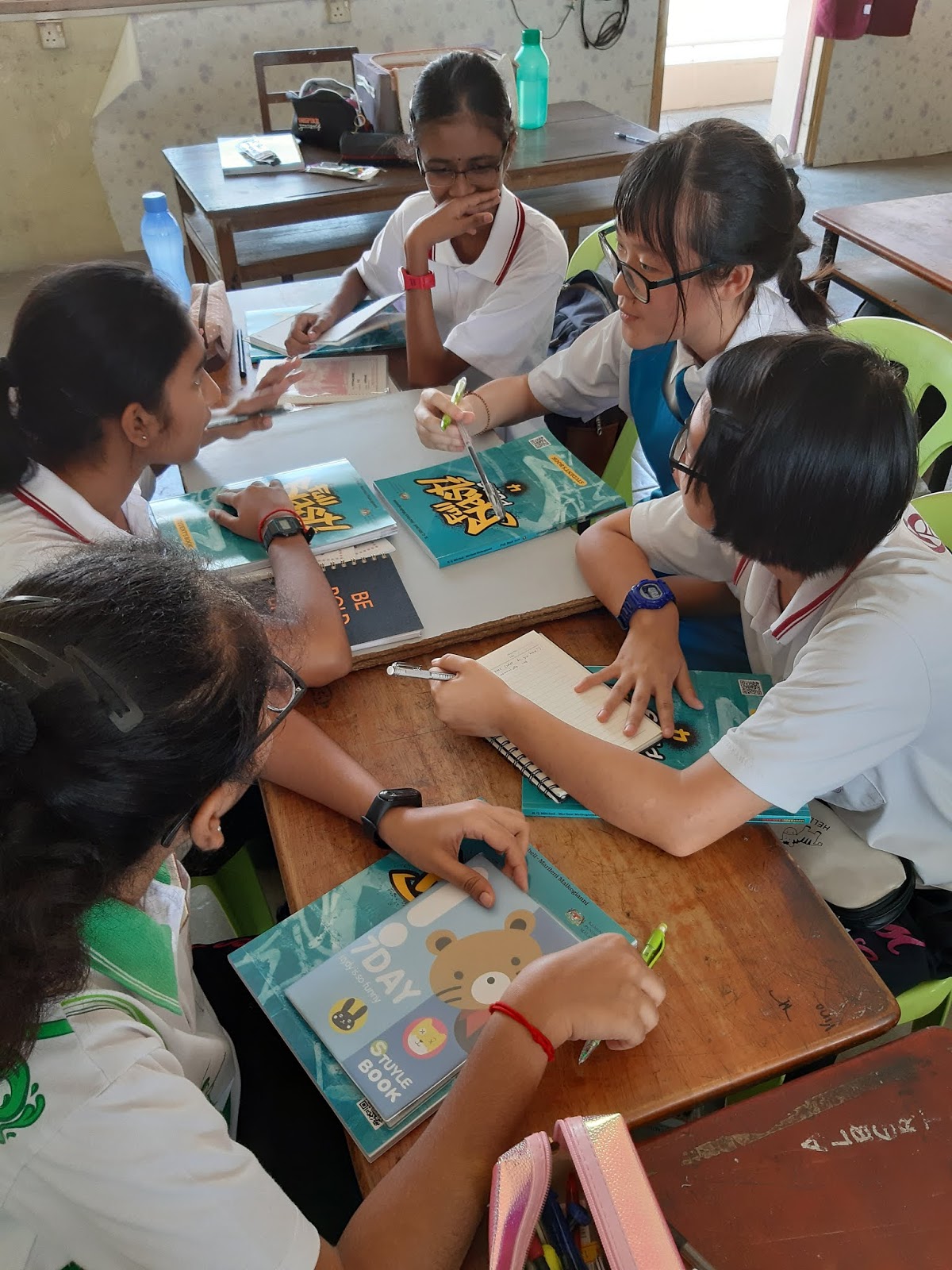
Before I began the lesson, I put my students into small groups and they remained in the same groups throughout the lesson.  

For the pre-reading activity, I wanted to activate students prior knowledge on social networking sites(SNS), so students were given three questions to be discussed in their groups. After discussion, each group choose a representative to share the outcome of the group discussion. The sharing session then led to the next activity. 
The first round of discussion is in progress 

For the next activity, students were required to read the text assigned to them individually. There were four students in a group and each of them was assigned one section of the text. I also prepared supplementary task sheets to help them with the reading activity. You may click here to download the task sheet. As they read, students were required to fill in the necessary information in the task sheet provided and share them during the discussion with the rest of the class. They were required to identify the opinions of each individual about SNS in the text and together with the opinion they were also identified reasons given for the opinions. After completing the task,  students exchanged their answers with members from other groups.
Students completing tasks given in the supplementary task sheet while reading the text.

Students completed the supplementary task individually before discussing as a group

A student sharing opinion  and reason 

Upon completing this, I drew students attention to the next activity in the task sheet, where they have to read through the entire text again as a group to identify the advantages and disadvantages of SNS. Again, to save time I asked them to complete the task in their respective groups. After completing the table, students were asked to shout out their answers for the teacher's approval. This activity is followed by task C and D in the student's book. 

Students found it easier to complete task C and D in the textbook as they had read the text more than twice and understood the opinions of each individual in the text through the supplementary task. 

The next activity was speaking, due to time constraint, students were required to stay put in the same groups. I used talking chips so that students will be focussed and know their roles. Each student was given 8 chips. The chips have three different colours. Two pink chips for questioning, three blue chips to respond to a statement/question/answer and three yellow chips for them to state their opinions. The speaking task was very organised due to the use of the talking chips. 


Students are engaged in speaking task using the talking chips.


As a closure for this lesson, a few students were randomly picked using ice-cream sticks to share what they have learnt today. 

Happy Teaching!!!


Thursday, 19 December 2019

Classroom Tools for Writing Lessons


The following are some tools that can be used during our writing lessons to enable our students to assess their own and peers' compositions before handing them in to the teacher. These rubrics have been designed in a way to make our students check for simple errors before submitting their work. 

Self - Assessment Rubric 
The self - assessment rubrics are designed to help students to check their own essays before submitting them. The rubrics here have listed a set of 'to-do' things that guides students to check their work. The lists are simple and understandable. Students can easily figure out what they have done and what they need to improvise before submitting the final work. As for the teacher, it would be easier for them as they would only need to work on the technical parts. The three editing checklist that I have shared here are different in their own ways. We can always alter and make minor changes to them so that the rubrics are well - aligned to the task given to the students. 

Self - Assessment Rubric 1 


Self - Assessment Rubric 2 


Self - Assessment Rubric 3 

Peer Assessment Rubric
The following are different types of peer assessment rubrics. These are different types of tools for different types of writing tasks and involves one or two peers as assessors depending on the task given. I have constructed these rubrics as simple as possible so that my students would understand what is stated in the rubrics. However, if you find them to be too difficult for your students you can always simplify these rubrics to suit your students learning needs.  


Peer Assessment Rubric for Descriptive Writing 

Peer Assessment Rubric for Paragraph Writing

Peer Editing Checklist

Peer Assessment Rubric 

Peer Grading Rubric
Teacher Assessment Rubric 
The teacher assessment rubric is designed for teachers to assess their students' work and give them scores for six different criteria and each criterion has three scores to show students what they have achieved and what they have to work on. This is in a way replicating the medal and mission model. 

Teacher Assessment Rubric - First Page 

Teacher Assessment Rubric - Second Page

You may download the rubric here

Happy Teaching! 
Related Posts Plugin for WordPress, Blogger...